Showing posts with label 1 and 2 year-olds. Show all posts

Friday, December 10, 2010

Waiting for Winter, by Sebastian Meschenmoser

Meschenmoser,Sebastian. Waiting for Winter. Kane Miller, 2009. 56 pages. $15.99, ISBN 978-1-935279-04-4


AGE LEVEL
1 and 2 year-olds

GENRE
Picture book

REVIEW
It's winter, and Squirrel, Hedgehog, and Bear have decided to wait to watch the first snowfall.  They have never seen snow before, and so are looking for something that resembles the description provided by Deer, who explained that snow is "white and wet and cold and soft".  Each animal finds an object which fits some of these requirements.  As they sit staring at Bear's choice (an old white sock), the real thing begins to fall.  Even though certain pages contain a large amount of text, others are wordless, making this book enjoyable for toddlers and preschoolers alike.  The colored pencil drawings are tenderly done in blacks, browns, and a wonderful orange-red for Squirrel.  They are appropriately a tad scruffy around the edges, as they depict, after all, wild animals. This humorous and highly recommended book is a great subtle reminder to children to be thorough when trying to find items to meet a certain set of criteria, a skill that will help them later in life.

LIBRARY PROGRAMMING IDEAS
This book could be shared at toddler storytime along with other books concerning the coming of winter, such as Here Comes Jack Frost by Kazuno Kohara, and Sleep, Big Bear, Sleep!, by Maureen Wright.

A Splendid Friend, Indeed, by Suzanne Bloom

Bloom, Suzanne. A Splendid Friend, Indeed. Boyds Mills Press, 2005. 32 pages. $8.95, ISBN 978-1590784884


AGE LEVEL
1 and 2 year-olds

GENRE
Picture book

REVIEW
As Bear is reading a book, Goose starts climbing his huge body.  He ends up at Bear's head, where he asks, “What are you doing?  Are you reading?”  Goose can’t help himself, as his favorite pasttime is chatting.  Bear prefers solitary silent activities such as reading books, writing, and thinking, and is at first annoyed by Goose’s questions, although he tolerates them.  However, when Goose writes a note to Bear, referring to him as “my splendid friend,” Bear is touched and joyful.  Due to its few words per page, engaging multi-shade blue and white illustrations, and the irresistible character of Goose, this book is very highly recommended for 1 and 2 year-olds.  This is a wonderfully humorous look at the theme of friendship.

Rain Play, by Cynthia Cotten

Cotten, Cynthia. Rain Play. Illustrated by Javka Steptoe. Henry Holt & Company, 2008. 32 pages. $16,95, ISBN 978-8050-6795-8


AGE LEVEL
1 and 2 year-olds

GENRE
Picture book

REVIEW
As this rhyming story begins, a group of children are playing at a park playground.  Suddenly, the sky grows dark and the weather changes.  Cotten writes, "Rain begins.  Cools our skins.  Raindrops splatter. People scatter."  The children continue playing for a while, stomping in puddles and making boats, among other things.  But when the storm begins in earnest, Dad appears in his car to scoop up his children and take them home.  The painted paper collage illustrations in this book are quite striking and the illustrator has achieved interesting shading effects, it appears by possibly wrinkling the paper at some point in the creative process.  The text per page is minimal, yet rhythmic and descriptive. For example, "Make a boat. Watch it float. A leaf's a cup.  Fill it up."  For its stunning visuals and brief text that moves the story along like poetry, this book is a great pick for 1 and 2 year-olds.

LIBRARY PROGRAMMING IDEAS
Share this story aloud at toddler storytime along with some nonfiction books about rain and storms.

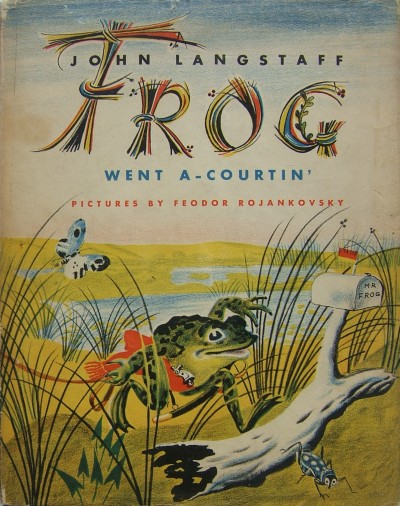
Frog Went A-Courtin', by John Langstaff

Langstaff, John. Frog Went A-Courtin. Illustrated by Feodor Rojankovsky. Harcout, Brace, Jovanovich, 1955. 32 pages. $7.00, ISBN 0-15-230214-X


AGE LEVEL
1 and 2 year-olds

GENRE
Traditional Literature (Folktale)

REVIEW
According to the foreword, this Caldecott Award winner is the retelling of a story which originated in Scotland over 400 years ago.  Frog decides he'd like to marry Miss Mouse, and so asks her for her hand.  Once she gets the approval of her Uncle Rat, the wedding is a go.  The last two-thirds of the story details the arrival of each of the wedding guests --  including a raccoon, a bumblebee, two ants, and a snake, among others -- and their contributions to the wedding day, such as fiddling, bringing cider, or laying the tablecloth, etc. Rojankovsky's ink and pencil illustrations depict the animals and insects in the story with accuracy and tenderness at the same time.  The artwork -- whether containing several colors in an image, or simply black and one other color -- is striking, and its style is suggestive of wood-cut printing in several instances.  Because the story rhymes, contains only two short lines per page and large illustrations, and is repetitive in its last two-thirds, it's a perfect choice for 1 and 2 year olds.

LIBRARY PROGRAMMING IDEAS
Here is a rhyme to accompany this book during toddler storytime:

          THE FROG

          A little green frog once lived in a pool,
          The sun was hot and the water cool.
          He sat in the pool the whole day long,
          And sung a dear little, queer little song,
          "Juaggery do, Quaggery dee,
          No one was ever so happy as me."

Let's Look at Winter, by Sarah L. Schuette

Schuette, Sarah L. Let's Look at Winter. Capstone Press, 2007. 24 pages. $21.00, ISBN 978-07368-6706-1
AGE LEVEL
1 and 2 year-olds

GENRE
Nonfiction (Seasons, Winter) 

REVIEW
This is a wonderful introduction to the winter season for 1 and 2 year-olds.  The text is broken up into four chapters concerning the signs of winter, animals and winter, plants and winter, and a brief mention of spring. On the left panel of each two-page spread are a couple sentences about winter.  Each chapter starts off with a question about the season, e.g., "How do you know its winter?" and is followed  by a simple answer, e.g., "The temperature is cold," or "Water freezes".  On each right panel, a large clear photograph of a wintry scene, a forest animal or bird lushly draws in our attention.  The text is followed by a glossary, suggestions of further reading on the topic, information on how to reach a Web site with supplemental information, and an index.  This book is clear, basic, informative, and eye-catching; an exemplary work of nonfiction for this age group which is a nice early introduction to the "chapter book" format.  An excellent way to encourage future nonfiction and science reading.

City Dog, by Karla Kuskin

Kuskin, Karla. City Dog. Clarion Books, 1994. 32 pages. $14.95, ISBN 0-395-66138-2


AGE LEVEL
1 and 2 year-olds

GENRE
Picture book

REVIEW
In very simple text and panoramic watercolor images, this story tells us about the first experience of a city dog in the countryside and at the seaside.  For the first time, she is able to run unbound by the city's organization and simply enjoy a whole new set of sights, such as trees, crabs, and waves.  At the end of the day, she and her family return home.  This book is recommended as it nicely encourages in children an excitement about exploring environments different to their immediate surroundings.  The family's return home at the end of the day lends a sense of security important to young children. However, while the watercolor illustrations are attractive, the depictions of the dog could have been a bit more detailed and interesting. But this does not detract from the fact that this is a very appropriate book for 1 and 2 year-olds.

The Neighborhood Mother Goose, by Nina Crews

Crews, Nina. The Neighborhood Mother Goose.  Greenwillow Books, 2004. 64 pages. $17.99, ISBN 0-06- 051573-2


AGE LEVEL
1 and 2 year-olds

GENRE
Traditional Literature (Nursery Rhymes)

REVIEW
In this delightful presentation of forty-one Mother Goose rhymes, Crews livens up these verses and makes them highly relevant to today's children by illustrating them with enormous clear photographs of African-American, Caucasian, and Latino children playing in an urban neighborhood.  A young boy gazes out his bedroom window at a star "like a diamond in the sky," a little "Jack" jumps "over the candlestick" on a cupcake,  and a "little girl" with a "little curl right in the middle of her forehead" stands poised to chop off Barbie's locks.  The delight of the children in these images is contagious.  Young listeners will enjoy the creative photography, as some of the shots contain miniaturized images of children.  This would be a great addition to any toddler or preschooler's personal library.  The rhyming and short nature of the verses make them accessible for both age groups.

LIBRARY PROGRAMMING IDEAS
Use these rhymes throughout the year of toddler and preschool storytimes, when one of the rhymes matches the storytime theme.

Thursday, December 9, 2010

Calendar, by Myra Cohn Livingston

Livingston, Myra Cohn. Calendar. Illustrated by Will Hillenbrand. Holiday House, 2007. 32 pages. $16.95, ISBN 978-0-8234-1725-4


AGE LEVEL
1 and 2 year-olds

GENRE
Poetry

REVIEW
This is a lovely mixed media look at the twelve months of the year.  Each two-page spreads depicts, in beautifully shaded paint and collage illustrations, a scene particular to each month.  Accompanying these images are short sentences of about two to five words each, such as "January shivers," "September whistles by," and "November is the fireplace".  Most pictures contain a smiling child engaged in an activity.  The exclusion of Santa Claus from December would have broadened the appeal of this book, yet this does not detract from this collection of absorbing images and succinct yet descriptive text.  This is likely to be hit with 1 and 2 year-olds.

Go Potty Go!: For Boys and Girls, by Mazzarella Media

Mazzarell Media. Go Potty Go!: For Boys and Girls. Mazzarella Media, 2007. 20 minutes. Price unknown, ISBN 1934119377  


AGE LEVEL
1 and 2 year-olds

GENRE
Nonfiction DVD (Potty Training) 

REVIEW
This DVD is concerned with teaching toddlers how to use the potty.  Animated characters Paige and Parker Panda introduce various topics related to using the potty, such as reducing fear of the potty, self-esteem concerns, self-hygiene. Other characters such as elephants, giraffes, and penguins are also included.  Two especially important pieces of information communicated to toddlers are that everyone goes to the bathroom, and how we know when we need to go to the bathroom.  It is possible to view the entire DVD or simply watch the music videos.  This DVD is recommended for 2 year-olds for the entertaining yet soothing, no-pressure way in which potty topics are addressed.

Mamá Goose: A Latino Nursery Treasury / Un Tesoro de Rimas Infantiles, by Alma Flor Ada & F. Isabel Campoy

Ada, Alma Flor & Campoy, F. Isabel. Mamá Goose: A Latino Nursery Treasury / Un Tesoro de Rimas Infantiles.  Illustrated by Maribel Suárez. Hyperion Books for Children, 2004. 121 pages. $19.99, ISBN 0-7868-1953-7


AGE LEVEL
1 and 2 year-olds

GENRE
Traditional Literature (Nursery Rhymes, Folklore)

REVIEW
This is a wonderful compendium of short nursery rhymes and other traditional literature from Spain and Latin America.  Included, with Spanish and English text side by side, are lullabies, finger games, lap games, sayings, nursery rhymes, jump-rope songs, riddles, song games, tall tales, proverbs, riddles, birthday songs, goodbye songs, and Christmas carols.  Sweet and colorful painted images of animals and moon-faced children illustrate each brief piece of  literature.  1 and 2 year-olds will be enthralled by these happy pictures, and 3 and 4 year-olds will enjoy repeating the often rhyming words.  A very brief introduction to Spanish and Latin American folklore and a table of contents precede the text, and an index of titles follows it.  The table of contents and the indexes are bilingual, but unfortunately the introduction to the book, and the introductions to each chapter appear only in English.  This is a highly unique must-have for any children's library collection.

LIBRARY PROGRAMMING IDEAS
This book would be a great accompaniment during a year of bilingual toddler or preschool storytime.  Rhymes and other pieces can be chosen as their associated themes come up in storytime.

Tuesday, December 7, 2010

Tuesday, by David Wiesner

Wiesner, David. Tuesday. Clarion Books, 1991. 30 pages. $7.99, ISBN 0395551137


AGE LEVEL
1 and 2 year-olds

GENRE
Picture book

REVIEW
As this Caldecott winner opens, a group of frogs, previously sleeping peacefully, are awakened by their lily pads' sudden levitation. The frogs are of course at first quite surprised, but eventually adjust to this development and settle in for their ride above marsh and suburbs, enjoying their new perspective, and the chance to scare a crow and a dog, wave to a man eating a late snack in his kitchen, and watch some television while an elderly woman sleeps. To me, the implications of this story are that anything is possible and that more amazing things happen in this world than most of us are aware. Tuesday is almost completely wordless, with the exception of the noting of the time and date on certain pages. For this reason, I feel that it's a great pick for all ages of young children, who can make up their own stories as they take in the illustrations.  The painted illustrations in their nighttime greens, purples, and blues with softly edged background images are lovely, but may be a bit too busy for babies, however. 

LIBRARY PROGRAMMING IDEAS
This book can be shared at toddler storytime along with some nonfiction books about frogs.

The Pigeon Finds a Hot Dog!, by Mo Willems

Willems, Mo. The Pigeon Finds a Hot Dog! Hyperion Books for Children, 2004. 40 pages. $14.99, ISBN 0-7868-1869-7


AGE LEVEL
1 and 2 year-olds

GENRE
Picture book

REVIEW 
As this story opens, Willems’ pigeon hero finds a hot dog, which he looks forward to scarfing down all by himself. This plan is threatened, however, when a duckling appears and begins asking a series of questions about the dog. Pigeon eventually begins to feel guilty about not offering to share the snack, and his distress leads to a hysterical scene in which he grapples with this moral dilemma.  In eight small cells over a two-page spread, Pigeon alternately paces, flaps, and sits overwhelmed, thinking aloud, "It's MY hot dog, right!? MINE! MINE! MINE!....I can't take it anymore!  What am I supposed to do?"  Readers will find out his decision and should pay close attention to Duckling's revealing last remark.  The minimal amount of text in this book and the simple yet fun cartoon drawings are perfect for 1 and 2 year olds. Pastel colors outlined in black pencil make for appealing images, and Willems manages to convey a range of emotions through Pigeon's expressive eyelid: from excitement, to suspicion, to full tantrum. A truly funny book which older children will love as well.

LIBRARY PROGRAMMING IDEAS
Here is a fingerplay related to sharing to accompany this book at toddler storytime:

          HERE'S A CUP

          Here's a cup,
          (cup one hand)

          And here's a cup,
          (cup the other hand)

          And here's a pot of tea.
          (make a teapot with 3 of the middle fingers bent over,
          thumb and little finger stuck out for spout and handle)

          Pour a cup,
          (make motion of pouring)

          And pour a cup,
          (make motion of pouring)

          And drink it up with me.
          (pretend to drink out of "cup")

In the Small, Small Pond, by Denise Fleming

Fleming, Denise. In the Small, Small Pond, 1993. 32 pages. $24.95, ISBN 0-8050-2264-3


AGE LEVEL
1 and 2 year-olds

GENRE
Picture book

REVIEW
This Caldecott honoree, a feast for the senses, describes the abundance of life in a little pond in words and pictures.  Several aspects about this book make it perfect for one to two year olds.  First of all, there are only four words on each two-page spread describing the activities of each animal.  Secondly, each of these phrases follows the same verb-verb-noun-verb pattern, such as “hover, shiver, wings quiver” or “circle, swirl, whirligigs twirl”.  And of course, the originality of Fleming’s artwork, created with colored cotton pulp and stencils, is enough to awakne anyone’s sense of wonder.  Striking blues, greens, and yellows of grasses, sky, and the pond itself form the backdrop for multi-hued images of brown and white geese swimming, purple fireflies skimming, and red lobsters crawling.  With its closing lines of “cold night, sleep tight, small, small pond”, this could even serve as a bedtime book.  Colorful dreams will be inspired by the images within.

LIBRARY PROGRAMMING IDEAS
A good pond-related rhyme to pair with this book at toddler storytime is:

          FUNNY DUCKY

          Waddle, waddle, waddle ducky,
          waddle to the pond.
          (place thumbs in armpits and waddle like a duck)

          Paddle, paddle, paddle ducky,
          paddle round and round.
          (paddle with hands)

          Tail up, head down, funny little duck.
          Tail up, head down, funny little duck.
          (move head downward and place hands behind back to represent tail)

The Lion & the Mouse, by Jerry Pinkney

Pinkney, Jerry. The Lion & the Mouse. Little, Brown Books for Young Readers, 2009. 40 pages. $16.99, ISBN 978-0-316-01356-7


AGE LEVEL
1 and 2 year-olds

GENRE
Traditional Literature (Fable)

REVIEW
Anyone who is not a fan of Aesop already is fairly likely to experience a change of heart after reading Pinkney's amazing Caldecott Award-winning rendition of "The Lion and the Mouse".  To start off with, every sketched and painted inch of lion, mouse, and landscape is beautifully multi-tonal in golds, browns, grays, and greens --  a true visual extravaganza.  But perhaps the most impressive aspect of the artwork is that the animals aren't caricatures; they are depicted as authentic creatures, along with the ambiguity that comes with this.  For example, when the lion decides to let the mouse go toward the beginning of the fable, one can literally see the mixed feelings in his eyes, and something more: the inscrutable nature of wild animals that prevents us from knowing exactly what his expression means.  The story is wordless except for a few animals sounds, such as the lion's "Grrr" and the mouse's "squeak".  True to the original fable, the mouse later remembers her debt to the lion, coming to his aid when he is caught by hunters.  For the beauty and accuracy of its illustrations of wild animals, and the way in which it highlights the potential for greatness in even the smallest and most unexpected of us -- whether this be the mouse's courage in initially approaching the lion, the lion's magnanimity in letting the mouse go, or the mouse's integrity in honoring her debt -- this book is very highly recommended for age 1 and up.

LIBRARY PROGRAMMING IDEAS
Due to the fact that Pinkney's drawings are very accurate in their depictions of wild animals, this book is the perfect lead-in to presenting some nonfiction books on mice and lions at toddler storytime

Sunday, December 5, 2010

All the World, by Elizabeth Garton Scanlon

Scanlon, Liz Garton. All the World. Illustrated by Marla Frazee. Beach Lane Books, 2009. 40 pages. $17.99, ISBN 978-1-4169-8580-8


AGE LEVEL
1 and 2 year-olds

GENRE
Poetry

REVIEW
With stunning illustrations and a thoughtful yet easy-to-understand rhyming text, this Caldecott honoree beautifully presents a poem about the common experiences in peoples' lives everywhere.  The text and images alternate between the experiences of individual families/groups and how these are played out in everyone's lives around the world. Scanlon and Frazee show that we all have our ups and downs.  For example, one scene shows families getting caught in an unexpected downpour, as the text notes, "Slip, trip, stumble, fall / Tip the bucket, spill it all / Better luck another day / All the world goes round this way". Yet the next scenes show how a bad day can turn around, as one of these rain-soaked families enjoys a warm meal lovingly prepared by the chefs at their local restaurant: "Table, bowl, cup, spoon / Hungry tummy, supper's soon / Butter, flour, big black pot / All the world is cold and hot".  1 and 2 year-olds will be transfixed by the gorgeous images of intimate scenes and breath-taking natural panoramas, will enjoy following the everyday adventures of several characters who recur throughout the book, and will love repeating the "All the world..." phrases.  An excellent book to encourage a sense of wonder and the knowledge that we humans are so much more alike than different.

LIBRARY PROGRAMMING IDEAS
Keeping in mind the scene of families and friends gathered together for a party toward the end of the book, one great action song to accompany this book during toddler storytime would be:

          COME ALONG AND SING WITH ME

          (to the tune of "Mary Had a Little Lamb", change the day of the 
          week as needed)

          Come along and sing with me, sing with me, sing with me,
          Come along and sing with me, on a Tuesday morning.

          Come along and clap with me, clap with me, clap with me,
          Come along and clap with me, on a Tuesday morning.

          Come along and roll with me....
          Come along and stretch with me....

Saturday, December 4, 2010

Where Do You Sleep, Little One?, by Patricia Hooper

Hooper, Patricia. Where Do You Sleep, Little One? Illustrated by John Winch. Holiday House, 2001.  40 pages. $16.95, ISBN 0-8234-1668-2

AGE LEVEL
1 and 2 year-olds

GENRE
Poetry

REVIEW 
On opening this lovely book, one is immediately secreted away into the woody and leafy bedtime world of animals and birds. On the endpapers, insects begin to scurry out from under leaves, followed by squirrels and mice poking out from behind bark and grass as the book itself begins. Artist John Winch has used oils,  handmade paper, and layered images to dramatic and completely unique effect. Patricia Hooper’s rhyming poem, suggestive of a lullaby, questions where a succession of animals sleep at night. For example, “Little fawn who ventures near, / Where are you when stars appear? / In the forest, dark and warm / I can slumber, far from harm.” The last scenes tenderly bring the child listener into the story, stating “Little pony, goat, and sheep, / What warm bed does someone keep….In our stable dreams are deep, / Little child. Now, go to sleep.” Although the phrases used to question each animal differ, the intent of the questions and the pattern of the answers is repeated each time, and there are few words on each page, making this a great choice for 1 and 2 year olds.  Children will be mesmerized by the textures and life in the arresting artwork.  An excellent choice to get one's own little ones ready for slumberland.

LIBRARY PROGRAMMING IDEAS
Pair this book with the following lullaby during toddler storytime:

          AUTUMN LULLABY 

          (With older two year-olds, you can use "darling" or another word 
          instead of "baby".)

          The sun has gone from the shining sky,
          Bye, baby, bye.
          The dandelions have closed their eyes,
          Bye, baby, bye.
          The stars are lighting their lamps to see,
          If babes and squirrels and birds and bees,
          Are fast asleep as they ought to be,
          Bye, baby, bye.

Meeow and the Pots and Pans, by Sebastien Braun

Braun. Sebastien. Meeow and the Pots and Pans. Boxer Books, 2010. 32 pages. $12.95, ISBN 978-1907152351


AGE LEVEL
1 and 2 year-olds

GENRE
Picture book

REVIEW 
On the opening page of this book, a happy black cat named Meeow greets us in a bright yellow apron and snappy red scarf.  Meeow and friends – a dog, cow, rabbit, and duck – are all in the kitchen and choosing pots, pans, and cooking utensils. The text details what each animal picks out, often noting the color of the object. The text alternates between describing the action and directly addressing the characters with comments and questions.  For example, "Moo finds three mixing bowls -- red, green, and purple.  Wobble, wobble!  Be careful, Moo!"  Although not the most exciting story, its ending has an interesting twist that makes reading the book worthwhile and may encourage creative thinking, as it is revealed that the animals will use the kitchen tools for something other than cooking. The simplicity of the story, its few words per page in an enormous font, and bold clear images make this book appropriate for 1 and 2 year olds.

LIBRARY PROGRAMMING IDEAS
After reading this book aloud at toddler storytime, children can make their own music with shakers, strings of bells, and other easily manipulable items.

Friday, December 3, 2010

Out of the Night, by Lola M. Schaefer

Schaefer, Lola M. Out of the Night. Illustrated by Roby Gilbert. Whispering Coyote Press, 1995.  32 pages. $14.95, ISBN 1-879085-91-7


AGE LEVEL
1 and 2 year olds

GENRE
Picture book

REVIEW
In this rollicking and rhyming bedtime counting story, a young boy meets two winged snakes, four witches, six trolls, eight vampires, ten ghosts, and twelve dragons.  Despite his dog and teddy bear's fright at these creatures, however, our protagonist is able to laugh off each of these potential threats, not worried at all.  Clues dropped throughout the illustrations are confirmed toward the end of the story when it is revealed that the reason for his lack of fear is that he has been reading about these monsters in a book.  But as soon as he closes its cover, another scary creature enters his room in a surprise ending.  The illustrations are the strongest aspect of this book, and they fill each page with color and energy.  They would be even more effective, however, if the pacing of the text were slightly altered.  As the text is currently laid out, the appearance of most of the monsters is immediately followed on the same page by the boy's amused reaction.  For example, "Out of the bushes and out of the brier fluttered eight black bats who were really vampires...I snickered!" It would seem that holding off the boy's reaction until the turn of the page would create more suspense.  However, this is a fun bedtime book, and also a good choice for older children who are learning to count by "twos".

LIBRARY PROGRAMMING IDEAS
This is a nice soothing lullaby which will complement this slightly scary story well at toddler storytime:

          CLOSE YOUR EYES

          Now it's time to say goodnight,
          Good night, sleep tight.
          Now the sun turns out its light,
          Good night, sleep tight.
          Dream sweet dreams for you.
          Dream sweet dreams for me.
         
          Close your eyes and I'll close mine.
          Good night, sleep tight.          
          Now the moon begins to shine,
          Good night, sleep tight.
          Dream sweet dreams for you.
          Dream sweet dreams for me.

          Close your eyes and I'll close mine.
          Good night, sleep tight.          
          Dream sweet dreams for you.
          Dream sweet dreams for me.

A is for Artist: A Getty Museum Alphabet, by the J. Paul Getty Museum

J. Paul Getty Museum. A is for Artist: A Getty Museum Alphabet. J. Paul Getty Museum, 1997. 64 pages. $16.95, ISBN 0-89236-377-0


AGE LEVEL
1 and 2 year-olds

GENRE
Nonfiction (alphabet, painting)

REVIEW
For each letter of the alphabet, this book includes a two-page spread.  One panel shows the letter boldly printed in huge colored font, along with a word that begins with this letter: "J is for jar," "N is for nut," "Y is for yawn," etc.  On the opposite panel is a small portion of a painting from the Getty's collection which illustrates the word.  In most cases, the images are very clear, and the object of focus cannot be missed.   The works of well-known artists such as Renoir, Alma Tadema, and Van Gogh are included, and striking works by lesser-known artists such as Van Huysum, Ensor, and Batoni are also in the book.  The name of the artist, their nationality, birth and death dates, and the name and date of the painting are given in fine print on the page with the letter.  Although the book does include some words which many young children will not have heard before, such as "tambourine" and "quill", the majority of words (e.g., "egg", "key", "grape", etc.) are those familiar in a young child's world, making this book suitable for 1 and 2 year olds.  Some of the paintings are a little bit dark in tone (color), but this does not detract from the book's overall appeal.

LIBRARY PROGRAMMING IDEAS
Toddlers can create their own paintings after a read-aloud of this book.

Thursday, December 2, 2010

Rap a Tap Tap: Here's Bojangles -- Think of That!, by Leo and Jane Dillon

Dillon, Leo & Jane. Rap a Tap Tap: Here's Bojangles -- Think of That!  Blue Sky Press, 2002. 32 pages. $17.99, ISBN 978-0439455978


AGE LEVEL
1 and 2 year-olds

GENRE
Picture book

REVIEW
This King Award honoree about the achievement and gifts of legendary tap dancer Bill Robinson (Bojangles) is an exemplary book on many levels.  First of all, the gouache artwork is quite striking, composed of layers of translucent paint depicting several copies of Bojangles' legs in each scene, showing his quick and graceful movements. The city dwellers whom Bojangles dances by are also illustrated in beautifully layered colors. The rhyming text of the book and repeated "Rap a tap tap -- think of that!" refrain makes this book perfect for 1 and 2 year-olds. And in the midst of all this -- while focusing mainly on the joy that Bojangles brought into peoples' lives -- the authors also ground their book in reality, alluding to the social climate of the early 20th century in lines such as "He danced past doors; some were open, some closed".  An afterword with some brief information on Bojangles' achievements is included. A visual feast and wonderful read aloud for all ages of children.

LIBRARY PROGRAMMING IDEAS
At storytime, this book could be followed by this dance for toddlers:

          CAN YOU POINT YOUR FINGERS AND DO THE TWIST?

          Can you point your fingers and do the twist?
          Can you point your fingers and do the twist?
          We're gonna go up
          And down,
          Go back up
          And turn around.
          Can you point your fingers and do the twist?

          Can you stand on one leg and shake your hands?
          Can you stand on one leg and shake your hands? 
          We're gonna go up
          And down,
          Go back up
          And turn around.
          Can you stand on one leg and shake your hands?