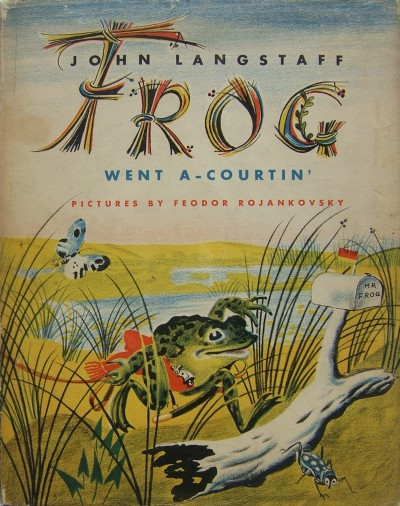
Langstaff, John. Frog Went A-Courtin. Illustrated by Feodor Rojankovsky. Harcout, Brace, Jovanovich, 1955. 32 pages. $7.00, ISBN 0-15-230214-X
AGE LEVEL
1 and 2 year-olds
GENRE
Traditional Literature (Folktale)
REVIEW
According to the foreword, this Caldecott Award winner is the retelling of a story which originated in Scotland over 400 years ago. Frog decides he'd like to marry Miss Mouse, and so asks her for her hand. Once she gets the approval of her Uncle Rat, the wedding is a go. The last two-thirds of the story details the arrival of each of the wedding guests -- including a raccoon, a bumblebee, two ants, and a snake, among others -- and their contributions to the wedding day, such as fiddling, bringing cider, or laying the tablecloth, etc. Rojankovsky's ink and pencil illustrations depict the animals and insects in the story with accuracy and tenderness at the same time. The artwork -- whether containing several colors in an image, or simply black and one other color -- is striking, and its style is suggestive of wood-cut printing in several instances. Because the story rhymes, contains only two short lines per page and large illustrations, and is repetitive in its last two-thirds, it's a perfect choice for 1 and 2 year olds.
LIBRARY PROGRAMMING IDEAS
Here is a rhyme to accompany this book during toddler storytime:
THE FROG
A little green frog once lived in a pool,
The sun was hot and the water cool.
He sat in the pool the whole day long,
And sung a dear little, queer little song,
"Juaggery do, Quaggery dee,
No one was ever so happy as me."
Showing posts with label traditional literature. Show all posts
Friday, December 10, 2010
Thursday, December 9, 2010
Mamá Goose: A Latino Nursery Treasury / Un Tesoro de Rimas Infantiles, by Alma Flor Ada & F. Isabel Campoy
Ada, Alma Flor & Campoy, F. Isabel. Mamá Goose: A Latino Nursery Treasury / Un Tesoro de Rimas Infantiles. Illustrated by Maribel Suárez. Hyperion Books for Children, 2004. 121 pages. $19.99, ISBN 0-7868-1953-7
AGE LEVEL
1 and 2 year-olds
GENRE
Traditional Literature (Nursery Rhymes, Folklore)
REVIEW
This is a wonderful compendium of short nursery rhymes and other traditional literature from Spain and Latin America. Included, with Spanish and English text side by side, are lullabies, finger games, lap games, sayings, nursery rhymes, jump-rope songs, riddles, song games, tall tales, proverbs, riddles, birthday songs, goodbye songs, and Christmas carols. Sweet and colorful painted images of animals and moon-faced children illustrate each brief piece of literature. 1 and 2 year-olds will be enthralled by these happy pictures, and 3 and 4 year-olds will enjoy repeating the often rhyming words. A very brief introduction to Spanish and Latin American folklore and a table of contents precede the text, and an index of titles follows it. The table of contents and the indexes are bilingual, but unfortunately the introduction to the book, and the introductions to each chapter appear only in English. This is a highly unique must-have for any children's library collection.
LIBRARY PROGRAMMING IDEAS
This book would be a great accompaniment during a year of bilingual toddler or preschool storytime. Rhymes and other pieces can be chosen as their associated themes come up in storytime.
AGE LEVEL
1 and 2 year-olds
GENRE
Traditional Literature (Nursery Rhymes, Folklore)
REVIEW
This is a wonderful compendium of short nursery rhymes and other traditional literature from Spain and Latin America. Included, with Spanish and English text side by side, are lullabies, finger games, lap games, sayings, nursery rhymes, jump-rope songs, riddles, song games, tall tales, proverbs, riddles, birthday songs, goodbye songs, and Christmas carols. Sweet and colorful painted images of animals and moon-faced children illustrate each brief piece of literature. 1 and 2 year-olds will be enthralled by these happy pictures, and 3 and 4 year-olds will enjoy repeating the often rhyming words. A very brief introduction to Spanish and Latin American folklore and a table of contents precede the text, and an index of titles follows it. The table of contents and the indexes are bilingual, but unfortunately the introduction to the book, and the introductions to each chapter appear only in English. This is a highly unique must-have for any children's library collection.
LIBRARY PROGRAMMING IDEAS
This book would be a great accompaniment during a year of bilingual toddler or preschool storytime. Rhymes and other pieces can be chosen as their associated themes come up in storytime.
Tuesday, December 7, 2010
The Lion & the Mouse, by Jerry Pinkney
Pinkney, Jerry. The Lion & the Mouse. Little, Brown Books for Young Readers, 2009. 40 pages. $16.99, ISBN 978-0-316-01356-7
AGE LEVEL
1 and 2 year-olds
GENRE
Traditional Literature (Fable)
REVIEW
Anyone who is not a fan of Aesop already is fairly likely to experience a change of heart after reading Pinkney's amazing Caldecott Award-winning rendition of "The Lion and the Mouse". To start off with, every sketched and painted inch of lion, mouse, and landscape is beautifully multi-tonal in golds, browns, grays, and greens -- a true visual extravaganza. But perhaps the most impressive aspect of the artwork is that the animals aren't caricatures; they are depicted as authentic creatures, along with the ambiguity that comes with this. For example, when the lion decides to let the mouse go toward the beginning of the fable, one can literally see the mixed feelings in his eyes, and something more: the inscrutable nature of wild animals that prevents us from knowing exactly what his expression means. The story is wordless except for a few animals sounds, such as the lion's "Grrr" and the mouse's "squeak". True to the original fable, the mouse later remembers her debt to the lion, coming to his aid when he is caught by hunters. For the beauty and accuracy of its illustrations of wild animals, and the way in which it highlights the potential for greatness in even the smallest and most unexpected of us -- whether this be the mouse's courage in initially approaching the lion, the lion's magnanimity in letting the mouse go, or the mouse's integrity in honoring her debt -- this book is very highly recommended for age 1 and up.
LIBRARY PROGRAMMING IDEAS
Due to the fact that Pinkney's drawings are very accurate in their depictions of wild animals, this book is the perfect lead-in to presenting some nonfiction books on mice and lions at toddler storytime
AGE LEVEL
1 and 2 year-olds
GENRE
Traditional Literature (Fable)
REVIEW
Anyone who is not a fan of Aesop already is fairly likely to experience a change of heart after reading Pinkney's amazing Caldecott Award-winning rendition of "The Lion and the Mouse". To start off with, every sketched and painted inch of lion, mouse, and landscape is beautifully multi-tonal in golds, browns, grays, and greens -- a true visual extravaganza. But perhaps the most impressive aspect of the artwork is that the animals aren't caricatures; they are depicted as authentic creatures, along with the ambiguity that comes with this. For example, when the lion decides to let the mouse go toward the beginning of the fable, one can literally see the mixed feelings in his eyes, and something more: the inscrutable nature of wild animals that prevents us from knowing exactly what his expression means. The story is wordless except for a few animals sounds, such as the lion's "Grrr" and the mouse's "squeak". True to the original fable, the mouse later remembers her debt to the lion, coming to his aid when he is caught by hunters. For the beauty and accuracy of its illustrations of wild animals, and the way in which it highlights the potential for greatness in even the smallest and most unexpected of us -- whether this be the mouse's courage in initially approaching the lion, the lion's magnanimity in letting the mouse go, or the mouse's integrity in honoring her debt -- this book is very highly recommended for age 1 and up.
LIBRARY PROGRAMMING IDEAS
Due to the fact that Pinkney's drawings are very accurate in their depictions of wild animals, this book is the perfect lead-in to presenting some nonfiction books on mice and lions at toddler storytime
Labels:
1 and 2 year-olds,
Caldecott,
fable,
greatness,
lions,
mice,
traditional literature
Sunday, December 5, 2010
Armadilly Chili, by Helen Ketteman
Ketteman, Helen. Armadilly Chili. Illustrated by Will Terry. Albert Whitman & Company, 2004. 32 pages. $7.95, ISBN 0-8075-0457-2
AGE LEVEL
3 and 4 year-olds
GENRE
Traditional Literature (Folktale)
REVIEW
A cold wind's blowing in a Texas desert town, and Miss Billie Armadilly is in the mood to make her special chili. All the friends she asks to help her collect beetles, pick peppers, and chop cactus in order to prepare the dish, however, are too busy doing their own thing to help her. Peeved, she makes the chili on her own and initially turns her friends down when they later show up on her doorstep to eat. However, Billie soon realizes that chili eaten alone is just not very tasty. Lucky for her, her friends have already realized their error and have returned to make amends. This book is a wonderful southwestern twist on the Little Red Hen story, and the regional details and the illustrations' lush blues, reds, and browns are very evocative of the story's locale. The engaging character of Billie alone is reason to read this book aloud -- even when miffed, she is adorable, and reminiscent of a sweeter Miss Piggy. A great book for 3 and 4 year-olds to explore important themes of friendship and helpfulness.
LIBRARY PROGRAMMING IDEAS
This book could be read aloud during preschool storytime along with other variations on the Little Red Hen story, such as Jerry Pinkney's traditional The Little Red Hen and The Little Red Hen Makes a Pizza, by Philemon Sturges
AGE LEVEL
3 and 4 year-olds
GENRE
Traditional Literature (Folktale)
REVIEW
A cold wind's blowing in a Texas desert town, and Miss Billie Armadilly is in the mood to make her special chili. All the friends she asks to help her collect beetles, pick peppers, and chop cactus in order to prepare the dish, however, are too busy doing their own thing to help her. Peeved, she makes the chili on her own and initially turns her friends down when they later show up on her doorstep to eat. However, Billie soon realizes that chili eaten alone is just not very tasty. Lucky for her, her friends have already realized their error and have returned to make amends. This book is a wonderful southwestern twist on the Little Red Hen story, and the regional details and the illustrations' lush blues, reds, and browns are very evocative of the story's locale. The engaging character of Billie alone is reason to read this book aloud -- even when miffed, she is adorable, and reminiscent of a sweeter Miss Piggy. A great book for 3 and 4 year-olds to explore important themes of friendship and helpfulness.
LIBRARY PROGRAMMING IDEAS
This book could be read aloud during preschool storytime along with other variations on the Little Red Hen story, such as Jerry Pinkney's traditional The Little Red Hen and The Little Red Hen Makes a Pizza, by Philemon Sturges
Labels:
3 and 4 year-olds,
animals,
armadillos,
friendship,
helpfulness,
Texas,
traditional literature
Saturday, November 27, 2010
Little Eight John, by Jan Wahl
Wahl, Jan. Little Eight John. Illustrated by Wil Clay. Lodestar Books, 1992. 30 pages. $14.99, ISBN 0-525-67367-9
AGE LEVEL
3 and 4 year-olds
GENRE
Traditional Literature (Folktale)
REVIEW
In memorable opening lines, Wahl establishes exactly the kind of little boy we are about to meet: "Once there was a fine-looking boy named Little Eight John. He looked fine. But he didn't act fine. He was as mean as mean there was." Little Eight John is a boy who just can't resist doing what he is not supposed to do, and who laughs at the bad fortune of others. If his mother advises him that climbing trees in his nicest outfit will bring grief to the family, up the nearest trunk he goes. When the family's potatoes won't grow as a result, John giggles. But as the conclusion of the story shows, no one can escape the consequences of meanness forever. Although there isn't a large amount of text in this book, a few pages may contain a bit more than is appropriate for 0-4 year olds. However, the repetitive nature of the story, with its sequence of several instances in which John deliberately disobeys his mother's wishes, compensates for these few longer pages. The tone is enjoyably conversational and the text includes direct address of the reader such as "Well sir, right then he had to go count his teeth." The illustrations, which appear to be drawn in colored pencil, fill each page with life and movement. The expressions on characters' faces are well detailed, reflecting a range of emotions. This Coretta Scott King award winner would make a fun read-aloud for preschoolers, and for many toddlers as well.
LIBRARY PROGRAMMING IDEAS
This story could be shared at a special periodic folktale storytime. Such folktale storytimes may help to make more patrons aware of the fact that there are many works of fiction in the portion of the library organized by Deewy Decimal numbers.
AGE LEVEL
3 and 4 year-olds
GENRE
Traditional Literature (Folktale)
REVIEW
In memorable opening lines, Wahl establishes exactly the kind of little boy we are about to meet: "Once there was a fine-looking boy named Little Eight John. He looked fine. But he didn't act fine. He was as mean as mean there was." Little Eight John is a boy who just can't resist doing what he is not supposed to do, and who laughs at the bad fortune of others. If his mother advises him that climbing trees in his nicest outfit will bring grief to the family, up the nearest trunk he goes. When the family's potatoes won't grow as a result, John giggles. But as the conclusion of the story shows, no one can escape the consequences of meanness forever. Although there isn't a large amount of text in this book, a few pages may contain a bit more than is appropriate for 0-4 year olds. However, the repetitive nature of the story, with its sequence of several instances in which John deliberately disobeys his mother's wishes, compensates for these few longer pages. The tone is enjoyably conversational and the text includes direct address of the reader such as "Well sir, right then he had to go count his teeth." The illustrations, which appear to be drawn in colored pencil, fill each page with life and movement. The expressions on characters' faces are well detailed, reflecting a range of emotions. This Coretta Scott King award winner would make a fun read-aloud for preschoolers, and for many toddlers as well.
LIBRARY PROGRAMMING IDEAS
This story could be shared at a special periodic folktale storytime. Such folktale storytimes may help to make more patrons aware of the fact that there are many works of fiction in the portion of the library organized by Deewy Decimal numbers.
Subscribe to:
Posts (Atom)


